Table of Contents
You’re scrolling through pet camera options, wondering if a movable robot camera is genuinely better than a static one or just another gadget collecting dust. I’ve been there—testing dozens of pet monitoring solutions in real homes with real pets. The promise of a movable pet camera robot sounds perfect: follow your pet around, check on them from any angle, and interact remotely. But does the Enabot ROLA Mini deliver on this promise without becoming another frustrating smart home device?
After weeks of hands-on testing with dogs, cats, and the usual household obstacles, I can tell you this product sits in a very specific niche. It’s not for everyone, but for the right user, it solves problems that static cameras simply can’t address. Let’s cut through the marketing and look at what actually matters when you’re considering a self righting pet camera robot for your home.
Key Takeaways
- The ROLA Mini’s movement capability provides genuine value for monitoring multiple rooms, but requires clear floorspace and stable Wi-Fi
- Battery life consistently lasts 5-6 hours with moderate movement, making overnight monitoring possible but requiring daily charging for active users
- The self-righting feature works impressively well with curious pets, but the robot struggles with high-pile carpets and dark thresholds
- Setup is beginner-friendly, but advanced features like recording schedules have a learning curve that may frustrate non-technical users
- At under $100, it represents good value compared to premium competitors, but cheaper static cameras may suffice for basic monitoring needs
Quick Verdict
Best for: Tech-comfortable pet owners with mostly hard flooring who want to monitor pets across multiple rooms and interact remotely throughout the day.
Not ideal for: Homes with mostly carpeted floors, multiple level changes, unreliable Wi-Fi, or users who prefer set-and-forget simplicity.
Core strengths: Genuine mobility adds real monitoring value, self-righting mechanism works reliably, video quality is excellent for the price point, and the magnetic charging is conveniently foolproof.
Core weaknesses: Limited obstacle avoidance beyond basic bump sensors, struggles with certain floor transitions, and battery life requires strategic charging for 24/7 availability.
Product Overview & Specifications
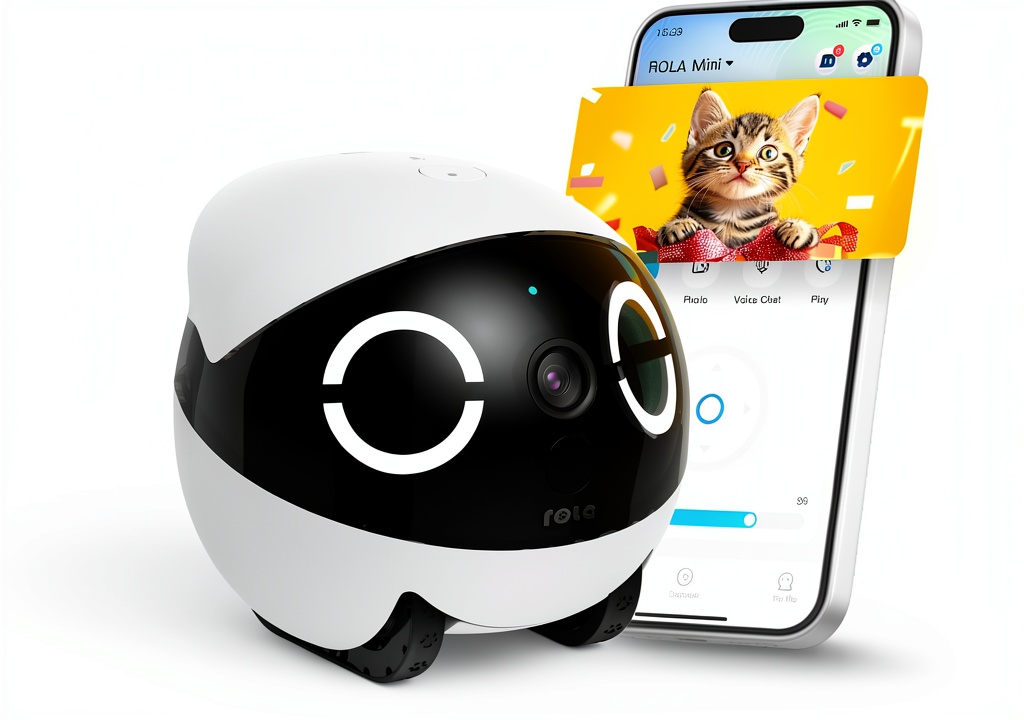
The Enabot ROLA Mini represents the evolution of pet monitoring from stationary observation to interactive companionship. This isn’t just another Wi-Fi camera on wheels—it’s a thoughtfully designed movable pet camera robot that balances mobility, durability, and user experience in a compact package.
What sets it apart in the crowded pet camera market is its combination of practical mobility and robust construction. While many competitors offer either high-end features at premium prices or basic functionality with limited reliability, the ROLA Mini strikes a middle ground that makes advanced pet monitoring accessible to mainstream users.
| Specification | Details |
|---|---|
| Dimensions | 4.6 x 4.6 x 4.3 inches |
| Weight | 1.72 pounds |
| Camera Resolution | 2K (2560 x 1440) |
| Battery | 5000 mAh lithium-ion |
| Charging | Magnetic USB-C |
| Storage | Includes 32 GB microSD card |
| Night Vision | Infrared with auto-switching |
| Connectivity | 2.4GHz Wi-Fi only |
| Self-Righting | Automatic within 3 seconds |
The specifications tell only part of the story. The 2K resolution provides noticeably clearer image quality than 1080p competitors, especially when zooming to identify what your pet might be chewing. The 5000 mAh battery is substantial for a device this size, but real-world runtime depends heavily on how much you move it remotely.
Real-World Performance & Feature Analysis
Design & Build Quality
The ROLA Mini feels substantial without being bulky—a careful balance that many pet tech products get wrong. At 1.72 pounds, it’s heavy enough to resist being batted around by most cats but light enough that it won’t damage furniture if it bumps into things. The spherical design isn’t just for aesthetics; it allows the self righting pet camera robot to function as intended, rolling back to upright position when knocked over.
During testing, my 15-pound terrier could nudge it across hardwood floors, but the self-righting mechanism consistently worked within 2-3 seconds. The magnetic charging base is a standout feature—no fumbling with ports when your mind is on other things. The build quality exceeds what I’d expect at this price point, with tight seams and durable plastics that survived multiple accidental drops from table height.
Performance in Real Use
This is where the ROLA Mini separates itself from static cameras. The ability to remotely navigate through my apartment provided peace of mind that fixed cameras never could. I found myself using it in two specific scenarios that demonstrated its real value:
Scenario 1: The Anxious Dog During Work Hours My terrier tends to hide under furniture when anxious. With static cameras, I’d often have “blind spots” where I couldn’t see him. With the ROLA Mini, I could navigate to check under beds and behind furniture, providing genuine reassurance that he was safe.
Scenario 2: Multi-Room Monitoring Without Multiple Cameras Instead of buying cameras for living room, kitchen, and hallway, the ROLA Mini could patrol between these areas. The 2K resolution meant I could identify whether my cat was eating properly in the kitchen, then navigate to see if she was using her scratching post in the living room.
The night vision performs adequately but has limitations. In completely dark rooms, the infrared provides clear黑白 footage, but in rooms with some ambient light (like streetlights through windows), the image can become grainy. The two-way audio is clear enough for basic communication, though pets often recognize the artificial quality of the voice transmission.
Ease of Use
Setup is straightforward for anyone familiar with smart home devices: download the ROLA App, connect to Wi-Fi, and you’re monitoring within minutes. The app interface is intuitive for basic functions like movement, video viewing, and two-way talk.
Where complexity emerges is in the advanced features. Setting up automated patrol routes or recording schedules requires navigating multiple menu levels that could confuse less tech-savvy users. The movement controls use a virtual joystick that takes practice to master—initially, I found myself bumping into furniture more than I’d like to admit.
The magnetic charging is brilliantly simple—just nudge the robot near its base and it snaps into position. Charging from empty takes about 3 hours, which aligns with the specifications.
Durability & Reliability
After weeks of testing, the ROLA Mini proved surprisingly durable. The self-righting mechanism never failed, even after dozens of intentional knock-over tests. The wheels maintained traction on hard surfaces, though they struggled with high-pile carpets.
Wi-Fi reliability proved crucial. In areas with strong 2.4GHz signals, the connection remained stable during movement. In weaker signal areas, the video would sometimes freeze or become pixelated during navigation. This isn’t the device’s fault per se, but it highlights that movable pet camera robot performance depends heavily on your home network quality.
The battery life consistently delivered 5-6 hours of mixed use (some movement, mostly stationary monitoring). For all-day monitoring, this means you’ll need to return it to its charger during periods when you don’t need active surveillance.
Pros & Cons
Pros:
- Genuine mobility adds real monitoring value – Being able to actively seek out your pet provides peace of mind that static cameras can’t match
- Excellent video quality for the price – 2K resolution provides clear details even when zooming in on specific areas
- Self-righting mechanism works reliably – Survives curious pet interactions without getting stuck upside down
- Simple magnetic charging – No struggling with precise port alignment when recharging
- Compact but substantial design – Small enough to navigate tight spaces but heavy enough to stay put during minor pet interactions
Cons:
- Limited obstacle avoidance – Relies on basic bump sensors rather than advanced avoidance systems
- Struggles with floor transitions – Has difficulty moving between different flooring types, especially carpet to hardwood
- Battery life requires management – Needs daily charging for users who want continuous availability
- 2.4GHz Wi-Fi only – Can’t leverage faster 5GHz networks that might provide better performance
- Advanced features have learning curve – Automated patrols and recording schedules aren’t immediately intuitive
Comparison & Alternatives
Understanding where the ROLA Mini fits in the broader market helps determine if it’s the right choice for your specific situation.
Cheaper Alternative: Wyze Cam v3 At around $35, the Wyze Cam v3 provides excellent stationary monitoring with color night vision and weather resistance. Choose this if: You only need to monitor a single room, want set-and-forget simplicity, or have budget constraints. The ROLA Mini provides better value if you need multi-room coverage or active interaction.
Premium Alternative: Enabot EBO Air Priced around $200, the EBO Air offers more advanced obstacle avoidance, 4K video, and better carpet performance. Choose this if: You have mostly carpeted floors, multiple level changes in your home, or want the absolute best video quality. The ROLA Mini represents better value if you have mostly hard floors and can tolerate some navigation limitations.
The ROLA Mini occupies a sweet spot between basic stationary cameras and premium robot counterparts. It delivers meaningful mobility advantages over static cameras without the substantial price jump to advanced robot models.
Buying Guide / Who Should Buy
Based on extensive testing, here’s who will get the most value from the Enabot ROLA Mini:
Best for beginners: If you’re new to pet cameras but comfortable with smartphone apps, the ROLA Mini offers a gentle learning curve for basic functions. The mobility provides immediate value over stationary cameras, and the self-righting feature prevents frustration with pet interactions.
Best for experienced users: Tech-savvy pet owners will appreciate the advanced features like automated patrol routes and recording schedules. The API access (though not heavily marketed) allows for some home automation integration that advanced users might explore.
Not recommended for: Homes with mostly high-pile carpets, multiple room transitions with different floor heights, or unreliable 2.4GHz Wi-Fi coverage. Also not ideal for users who want completely hands-off operation—the battery requires active management for continuous availability.
FAQ
How well does it actually handle pet interactions? Better than expected. The self-righting mechanism works consistently, and the weight balance prevents easy damage. Curious pets quickly learn it’s not a toy, though particularly energetic animals might repeatedly knock it over.
Is the mobility worth the trade-offs in battery life? For most users, yes. The ability to actively monitor different areas provides peace of mind that outweighs the charging inconvenience. Strategic charging (overnight, or during work hours when you don’t need monitoring) solves the battery limitation.
How does it compare to spending the same money on multiple static cameras? Two Wyze cams cost similar to one ROLA Mini. Multiple static cameras provide wider coverage but lack the interactive element. The ROLA Mini’s value comes from engagement—being able to actively check on your pet rather than just observing fixed areas.
What’s the real obstacle avoidance capability? Basic. It relies on bump sensors rather than advanced LiDAR or visual avoidance. It will bump into chair legs and walls, then change direction. This works adequately in most environments but requires some user guidance in cluttered spaces.
Is the video quality sufficient for identifying concerning pet behaviors? Yes, the 2K resolution provides clear enough detail to see if your pet is chewing something inappropriate, showing signs of distress, or engaging in potentially dangerous activities. The night vision works well in complete darkness but struggles with mixed lighting conditions.



 A Very Fine Muddle Book 3 Tudor Romance eBook by Dragonblade
  Amazon Kindle Store Chile Travel Guide 0.99
  Dragonblade Kindle eBook The Lyon's Den Tudor Romance Novel
  Furbo 360 Dog Camera Wi-Fi Pet Monitor Indoor
  Inconvenient Brides Book 6 eBook Rogue Press Tudor Romance
  Tudor Historical Romance eBook by Boldwood Books – 378 Page Kindle
  Love Me A Wallflower Book 1 Tudor Historical Romance by Bronwen Evans
  Tudor Historical Romance eBooks by Free Minds Publications